Table of Contents
- Introduction: The Shift from Manual to Intelligent Supply Chains
- The Early Days: Manual Tracking and Limited Visibility
- The Digital Transformation: ERP and Automation
- The Rise of AI Agents in Supply Chain Management
- Key Benefits of AI Agents for Logistics & Supply Chain
- Real-World Applications of AI in Supply Chain
- Why Businesses Partner with Service Hive for AI-Driven Logistics
- Conclusion
- FAQs
Introduction: The Shift from Manual to Intelligent Supply Chains
For decades, supply chain management relied on manual tracking, spreadsheets, and static reporting. Businesses faced delays, miscommunication, and rising costs due to limited real-time visibility.
Today, the scenario has changed completely. With the rise of AI Agents and automation systems, logistics has become smart, predictive, and data-driven. Companies are no longer reacting to problems — they are anticipating and preventing them.
That’s the transformation we’re now witnessing — from manual tracking to intelligent automation.
The Early Days: Manual Tracking and Limited Visibility
In the early stages, logistics teams managed operations using paper logs, phone updates, and human monitoring.
Common challenges included:
- Lost or delayed shipments
- Human errors in data entry
- Lack of real-time inventory visibility
- Inefficient route planning
These issues made scalability difficult. As supply chains expanded globally, businesses began looking for technology-based solutions to streamline operations.
The Digital Transformation: ERP and Automation
The next phase came with Enterprise Resource Planning (ERP) systems and barcode scanning. Businesses started integrating inventory management, tracking software, and CRM tools.
While this brought some visibility, it still lacked intelligence.
ERP systems could show what was happening — but not why or what should happen next.
That gap paved the way for AI-driven decision-making, where AI Agents began taking charge of repetitive and predictive tasks.
The Rise of AI Agents in Supply Chain Management
AI Agents are intelligent software systems designed to analyse data, make decisions, and automate complex workflows. In logistics, they act as virtual managers — continuously monitoring, predicting, and optimizing processes.
How AI Agents Work
- Data Integration: Collect data from sensors, GPS, IoT devices, and ERP systems.
- Pattern Recognition: Identify trends such as frequent delays or bottlenecks.
- Predictive Decisions: Suggest route changes, reorder inventory, or notify suppliers automatically.
- Autonomous Action: Execute low-risk tasks like scheduling deliveries or updating dashboards without human input.
According to McKinsey & Company, companies using AI in supply chain operations have seen up to 35% lower inventory costs and 65% fewer lost sales due to better forecasting.
Key Benefits of AI Agents for Logistics & Supply Chain {#benefits}
- End-to-End Visibility – AI Agents provide real-time tracking across suppliers, transporters, and warehouses.
- Predictive Maintenance – AI identifies equipment or vehicle issues before breakdowns occur.
- Optimized Routing – Routes are automatically adjusted based on weather, traffic, or fuel efficiency.
- Inventory Accuracy – No more stockouts or overstocking — AI balances demand and supply dynamically.
- Reduced Human Error – Automation handles data entry, scheduling, and notifications more reliably.
- Sustainability Gains – By optimizing routes and loads, AI Agents help reduce emissions and waste.
Real-World Applications of AI in Supply Chain
Here’s how businesses are already benefiting from AI-driven systems:
Use Case | AI Agent Function | Business Impact | Fleet Optimization | Analyses real-time GPS and fuel data | Cuts fuel cost by 15–20% | Inventory Forecasting | Predicts demand with accuracy | Reduces overstocking losses | Warehouse Automation | Assigns picking and sorting tasks | Increases fulfillment speed | Supplier Performance Tracking | Scores vendors based on reliability | Improves delivery efficiency |
|
These applications make logistics more resilient, cost-effective, and adaptive — even in uncertain global conditions.
A Deloitte report found that 79% of organizations integrating AI agents in logistics improved delivery timelines and overall customer satisfaction.
Why Businesses Partner with Service Hive for AI-Driven Logistics {#service-hive}
Service Hive is more than a technology provider — we’re a strategic AI transformation partner.
We specialize in building AI Agent ecosystems that integrate seamlessly into your existing logistics stack.
Our solutions include:
- Custom AI Agent development for predictive operations
- Integration with ERP, IoT, and telematics systems
- Real-time dashboards with actionable insights
- Scalable cloud and DevOps infrastructure
By combining AI intelligence with business logic, we help logistics companies move from reactive operations to proactive intelligence.
Learn more about how Service Hive is transforming logistics: AI & Automation Services
Conclusion
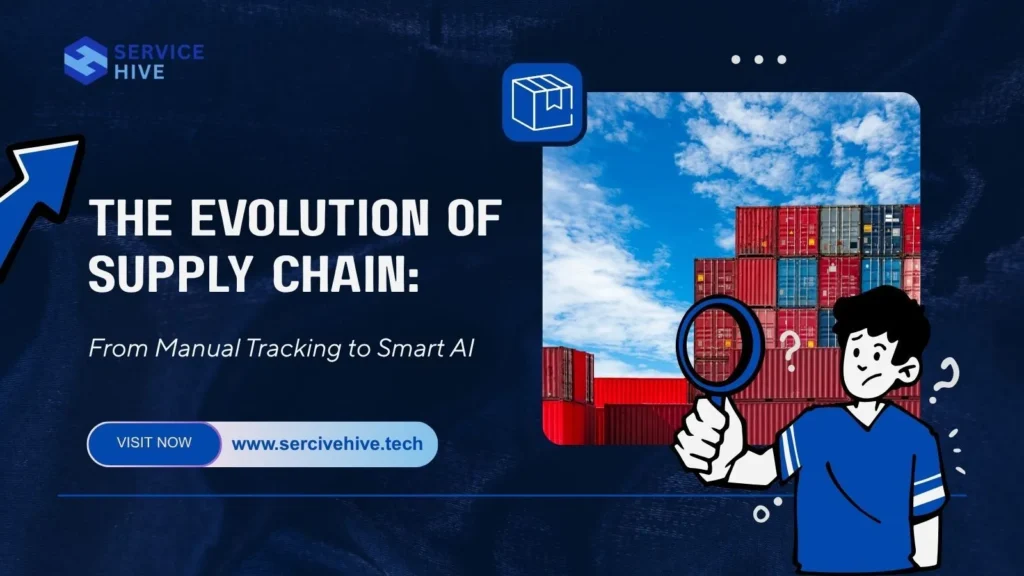
The evolution of supply chains from manual tracking to AI automation is not just a technological upgrade — it’s a strategic shift toward resilience and efficiency.
As the industry grows more complex, AI Agents will become the backbone of logistics, empowering companies to operate smarter, faster, and more sustainably.
If you’re ready to modernize your logistics operations, Service Hive can help you deploy AI-powered supply chain automation that drives measurable ROI.
FAQs
- What are AI Agents in supply chain management?
AI Agents are intelligent software systems that automate, predict, and optimize logistics processes — from tracking shipments to forecasting demand. - How do AI Agents improve logistics efficiency?
They analyse real-time data, identify issues, and make proactive adjustments to routes, inventory, and resource allocation. - Can AI Agents integrate with existing ERP systems?
Yes. Service Hive’s AI solutions integrate seamlessly with ERP, IoT, and tracking tools. - What ROI can companies expect from AI-driven logistics?
On average, businesses see 15–30% cost savings and faster delivery times through optimized workflows. - How can I get started with Service Hive’s AI Agent solutions?
You can schedule a free consultation through the Service Hive website.